If you want to find a townhome in Alexandria with real upside, you need more than a good eye for dated finishes. In a competitive market, the best value-add opportunities are usually the homes that look tired on the surface but still have the right bones underneath. If you know what to look for, you can avoid expensive surprises and focus on improvements that actually move value. Let’s dive in.
Why value-add still works in Alexandria
Alexandria remains a competitive market for attached homes, which means value-add deals do exist, but they are not usually obvious. In March 2026, the citywide median sale price was about $645,000, homes sold in 31 days on average, and 37.3% of homes sold above list price. That kind of market rewards buyers who can move quickly and underwrite carefully.
At the same time, there are a few signs that buyers may have slightly more room than they did during the tightest market stretch. NVAR’s 2025 Alexandria data showed a median townhome price of $888,364, with 591 annual townhome sales and average month-end inventory of 44 units. NVAR’s 2026 forecast calls for the townhome median to rise 2.5%, sales to rise 3.5%, and inventory to increase 21.9%.
That matters because value-add buyers do not need a soft market to win. They need enough selection to compare options, enough discipline to skip weak deals, and enough local knowledge to spot a stale or mispriced listing before someone else does.
Know where Alexandria price ceilings sit
One of the biggest mistakes buyers make is using the wrong benchmark for after-repair value. Alexandria is not one uniform market, and citywide pricing can hide major differences between neighborhoods. If you are buying a townhome or duplex with plans to improve it, your comp set needs to stay hyper-local.
Close-in neighborhoods often set the top end of the attached-home price ladder. In March 2026, Old Town had a median sale price of about $1.0975 million, Del Ray was $945,000, Parker-Gray Historic District was $914,950, and Rosemont Historic District was $955,000. Those numbers show why a renovation that works in one part of Alexandria may not pencil the same way in another.
Recent sales also show how wide the spread can be even within similar product types. In Old Town, 1118 Princess St sold for $780,000, 1014 Colonial Ave sold for $917,500 after kitchen and system upgrades, and 720 Gibbon St sold for $1,303,077. In Del Ray, 211 Guthrie Ave sold for $850,000, while in Jefferson Manor, 5716 Tremont Ct sold for $860,000 after a full redesign.
The lesson is simple: block, condition, parking, yard space, lower-level finish, and layout all matter. A good Alexandria value-add strategy starts with realistic neighborhood-specific ceilings, not broad market averages.
What a strong value-add candidate looks like
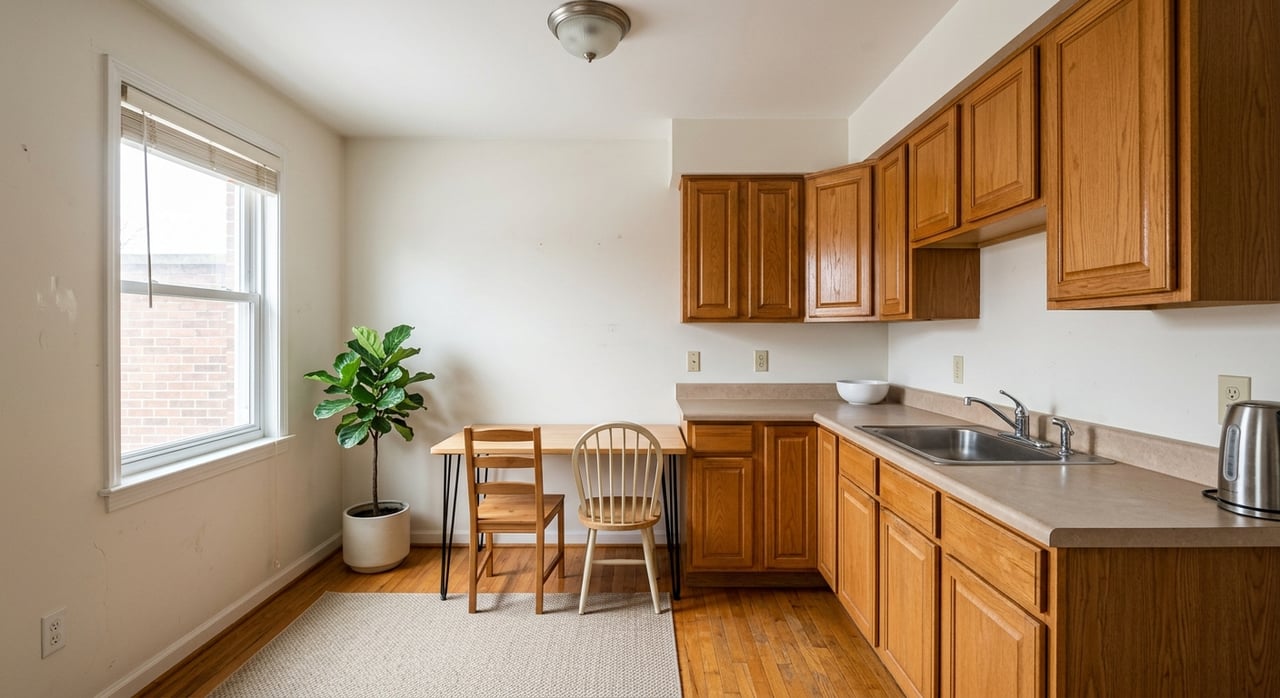
In Alexandria, the best opportunities are often not major fixer-uppers. They are more likely to be homes sold as-is or homes with dated interiors that scare off buyers who do not want a project. That can create room for a buyer who is comfortable with cosmetic updates and targeted system work.
A strong candidate usually has a few things going for it already. The structure is functional, the layout is workable, and at least some major systems may already be updated. If the home needs paint, flooring, kitchen and bath updates, and finish-level improvements, that is often a different risk profile than a home with structural unknowns or a full layout redesign.
The examples in Alexandria support that pattern. 1004 Colonial Ave in North Old Town was listed as-is at $825,000, with nearby comparable sales ranging from about $783,250 to $939,900. 3906 Vermont Ave sold as-is for $490,000 and already had a 2024 roof, 2024 gas furnace, fresh paint, and a partially finished basement, while 6933 Westhampton Dr sold as-is for $505,000 with a driveway, fenced yard, rear deck, and finished lower level.
Those examples point to a useful screening rule: cosmetic issues are easier to price and control than functional problems. If the visible flaws are bigger than the underlying mechanical ones, you may be looking at a more manageable project.
Use a practical screening checklist
Before you get too excited about a townhome with upside, it helps to run through a basic filter. In this market, a deal is often won or lost before the offer is written.
Look for these signs of a stronger value-add opportunity:
- Dated kitchen and baths, but a usable existing layout
- Older flooring, paint, lighting, or trim that can be improved without major construction
- Evidence of recent system updates like roof, HVAC, or water heater
- A finished or partially finished lower level that already adds functional space
- Features that support resale value, such as parking, outdoor space, or a fenced yard
- Pricing that sits clearly below renovated neighborhood comps
- A listing that has lingered or seen a price drop
In March 2026, 22.9% of Alexandria homes had price drops. That does not mean every reduced listing is a deal, but it does suggest there may be openings for buyers who stay disciplined and do not chase every fresh listing at full speed.
Watch the renovation scope carefully
In Alexandria, value is often created by controlling scope, not by taking on the biggest project. That is especially true for townhomes and duplexes, where layout changes, exterior changes, and permit requirements can reshape your budget fast.
The safest projects are often the ones where the floor plan already works reasonably well. If you can improve the kitchen, baths, flooring, paint, lighting, and basement finish without moving major walls or rebuilding the rear of the house, your timeline and cost exposure are usually easier to manage.
This is also why some buyers overpay for the idea of potential. Potential only matters if the work is actually feasible, permitted, and supported by comps when it is done. In Alexandria, the margin for error gets thinner when you assume a major reconfiguration will be easy.
Understand Alexandria permit rules
One of the most important parts of value-add planning happens before closing. Alexandria requires permits for most construction and maintenance work, including alterations, demolitions, renovations, additions, and maintenance. For townhomes, rowhouses, and duplexes, even projects that seem straightforward can trigger permit review.
That can include:
- Kitchen remodels
- Basement finishing
- Deck construction
- Fence installation
- Retaining walls
- Additions or larger exterior changes
The practical takeaway is to check permitability early. If a project depends on a certain scope of work to make the numbers work, you want clarity before you finalize your budget assumptions.
Historic districts can change the plan
If you are looking in areas like Old Town or Parker-Gray, historic rules can materially affect what you can do outside the home. Alexandria requires a Certificate of Appropriateness for new construction and exterior alterations visible from a public right of way in local historic districts. A Permit to Demolish is also required for demolition or capsulation of more than 25 square feet of material.
Interior work does not require Board of Architectural Review approval, which is an important distinction. A straightforward interior renovation may still be very workable, while an exterior design idea could face a longer process or more limitations. If your value-add plan relies heavily on exterior changes, this is a key issue to evaluate upfront.
Be careful with basement rental assumptions
Some buyers look at a lower level and immediately imagine rental income helping offset the project. In Alexandria, that assumption needs extra scrutiny. The city notes that placing an apartment in a basement currently requires a Special Use Permit.
That means a basement income strategy may not be just a construction decision. It may also become a zoning and approvals question. If the deal only works because you are counting on future rental income, make sure you understand that added layer before moving forward.
Build ARV from the street level up
A smart ARV process in Alexandria starts with same-neighborhood sold comps for the same property type. Then you adjust for the details that buyers actually pay for in this market, including square footage, parking, bath count, yard, finished lower level, and any historic-district limitations.
This matters because neighborhood medians vary sharply. Old Town at about $1.0975 million is not the same market as the citywide median of $645,000. If you use a broad average, you can easily overestimate value in one pocket or underestimate it on a stronger block.
The safest deals are usually the ones where the purchase price sits clearly below the local renovated-comp range and the work is mostly cosmetic or system-focused. In Alexandria, strong outcomes are usually created by buying correctly and staying disciplined on scope, not by hoping appreciation will cover a weak plan.
Where buyers can find better odds
In practical terms, your best odds often come from homes that are a little overlooked for understandable reasons. Maybe the finishes are dated, the listing language says as-is, or the home needs a cleaner renovation vision than most buyers can picture. Those are often easier opportunities than homes with structural uncertainty or ambitious expansion plans.
You may also find stronger entry points outside the highest-priced micro-markets. The as-is sales at 3906 Vermont Ave in 22304 and 6933 Westhampton Dr in 22307 show how entry pricing can differ significantly from close-in neighborhood pricing. That does not automatically make them better deals, but it does show how buying in the right pocket can create a wider renovation margin.
Why local guidance matters
Spotting a value-add townhome in Alexandria is about more than finding ugly finishes. You need to understand neighborhood-specific resale ceilings, permit realities, historic limitations, and which improvements tend to matter most to future buyers. That is where hands-on local guidance can make a real difference.
If you are weighing an older townhome, duplex, or as-is property, it helps to have someone who can pressure-test the scope before you commit. The right property can create meaningful upside, but only if the numbers, the work, and the neighborhood all line up.
If you want help evaluating Alexandria townhomes with renovation potential, connect with Derek Mathew Cole for a free consultation.
FAQs
What makes an Alexandria townhome a good value-add opportunity?
- A strong value-add townhome usually has dated cosmetic finishes, a workable layout, and solid underlying systems or recent system updates.
How competitive is the Alexandria townhome market?
- Alexandria remains competitive, with citywide homes selling in 31 days on average in March 2026 and 37.3% selling above list price, though rising inventory may give buyers a bit more room to shop.
Which Alexandria neighborhoods set the strongest townhome comps?
- Close-in areas like Old Town, Del Ray, Parker-Gray Historic District, and Rosemont Historic District often set the benchmark for renovated attached-home values.
Do Alexandria townhome renovations usually require permits?
- Yes, Alexandria requires permits for most construction and maintenance work, including many renovations that buyers might assume are minor.
Do historic district rules affect Alexandria townhome projects?
- Yes, exterior changes visible from a public right of way in local historic districts may require a Certificate of Appropriateness, while interior work does not require that approval.
Can you add a basement apartment to an Alexandria townhome?
- Alexandria notes that placing an apartment in a basement currently requires a Special Use Permit, so that strategy needs careful review before you rely on rental income in your plan.